Successful Permanent Magnet Motor Performance in Unconventional Gassy Well Applications through Modern VFD Technology
This presentation explains how modern Variable Frequency Drive (VFD) technology enables reliable operation of Permanent Magnet Motors (PMMs) in unconventional, gassy oil wells. Laboratory testing shows that traditional scalar control leads to poor speed control, loss of rotor synchronization, and lower efficiency, while vector control provides stable operation, better efficiency, and maintains synchronization under varying loads. Field case studies from the Permian Basin confirm that properly configured vector-controlled VFD systems can effectively manage gas interference and fluctuating loads, improving overall ESP performance in challenging well conditions.
Successful Permanent Magnet Motor Performance in Unconventional Gassy Well Applications through Modern VFD Technology Read More

Internal Flow Visualization of Gas Core Dynamics in Paddle Type Rotary Gas Separators under Slug Flow Conditions

This study utilizes a specialized experimental facility to visualize and characterize the internal flow dynamics of a paddle-type rotary gas separator (RGS), specifically evaluating how it handles high-volume gas cores from intermittent slug flow environments. Testing was conducted in a small-scale flow loop featuring a transparent polycarbonate casing, allowing high-speed cameras to record the transit of a gas core created by releasing a Taylor bubble via a gas bypass line into a baseline single-phase liquid flow. The results demonstrate that the RGS successfully mitigates gas carry-over into the pump stages across a tested Gas-Liquid Ratio (GLR) range of 200 to 700 scf/bbl. Furthermore, high-speed visualization reveals that rotational speed dictates the physical structure of the gas phase: high-RPM operation sustains a stable, centralized gas core, whereas low-RPM operation fragments the incoming gas core into smaller gas pockets. Notably, a persistent gas-trapping phenomenon was discovered within the separation chamber immediately after gas flow termination, failing to vent naturally and highlighting an operational risk for gas-locking during transient conditions or pump restart sequences. Ultimately, the study concludes that the RGS serves as a robust buffering mechanism that stabilizes internal gas distribution, providing a new diagnostic framework to optimize Variable Speed Drive (VSD) control strategies and improve ESP reliability in high-GLR unconventional applications.

Internal Flow Visualization of Gas Core Dynamics in Paddle Type Rotary Gas Separators under Slug Flow Conditions Read More

Beyond Siloed Data: Lessons from Four Years of Permian Operator ESP Benchmarking

ESP reliability in the Permian Basin is a function of the Basin�s harsh and rapidly changing conditions, but reliability can also be significantly affected by technology selection and operating strategies. In the Permian Basin, a group of ESP operators have been sharing ESP reliability data and learnings for four years to collaboratively move towards higher reliability and reduced downtime.

Beyond Siloed Data: Lessons from Four Years of Permian Operator ESP Benchmarking Read More

High Speed ESP –Overcome Dogleg Severity challenges in Permian

“This field study demonstrates that high-speed ESP systems offer a robust solution to the geometric and operational constraints posed by high DLS wells. ​

By enabling deeper ESP placement through challenging well trajectories, the compact system achieved substantial improvements in production rates, energy efficiency, and operational stability compared to conventional ESP designs. ​

The shortened ESP string, engineered for flexibility and equipped with advanced motor and pump technologies, restored drawdown efficiency, minimized gas lock events, and enhanced motor cooling, even in wells with limited tangent sections and extreme tortuosity. ​”

High Speed ESP –Overcome Dogleg Severity challenges in Permian Read More

Surface-Based Predictive Monitoring for Electric Submersible Pumps Using Electrical Signature Analysis

SAM4 monitors Electric Submersible Pumps from the surface by reading current and voltage signatures at 20,000 samples per second from the motor control cabinet. A 20-ESP Permian Basin pilot detected sine-wave filter failure four days before a VFD trip, identified cable plug degradation, and confirmed gas-locking events without well intervention. Installation cost is an order of magnitude below downhole gauges, and outbound data traffic stays below 2 GB per ESP per month.

Surface-Based Predictive Monitoring for Electric Submersible Pumps Using Electrical Signature Analysis Read More

Panel 1 – What ChatGPT Won’t Tell You – Tackling Optimization through Innovation

“Panelists are Dakai Yin (Oxy), Michael Romer (ExxonMobil), Derek Meier (SLB), and Simon Suarez (Flowco), moderated by Shannon Kennedy (C-FER). The slides pose discussion questions, each paired with an AI-generated answer from ChatGPT, as a foil for the panel’s real-world views. The AI answers include:

Real-time data and analytics are what the industry gets right.
Unconventional optimization is harder because of variability, gas, solids, and limited data.
Full autonomy is overhyped, while data quality and operational discipline are underappreciated.
Only a few signals truly drive decisions.
Experienced operators still beat algorithms on novel situations and judgment calls.
Success should be measured as sustainable value, balancing production and reliability.
Trials should run 5–10 wells for 2–6 months, starting with trouble wells.”

Panel 1 – What ChatGPT Won’t Tell You – Tackling Optimization through Innovation Read More

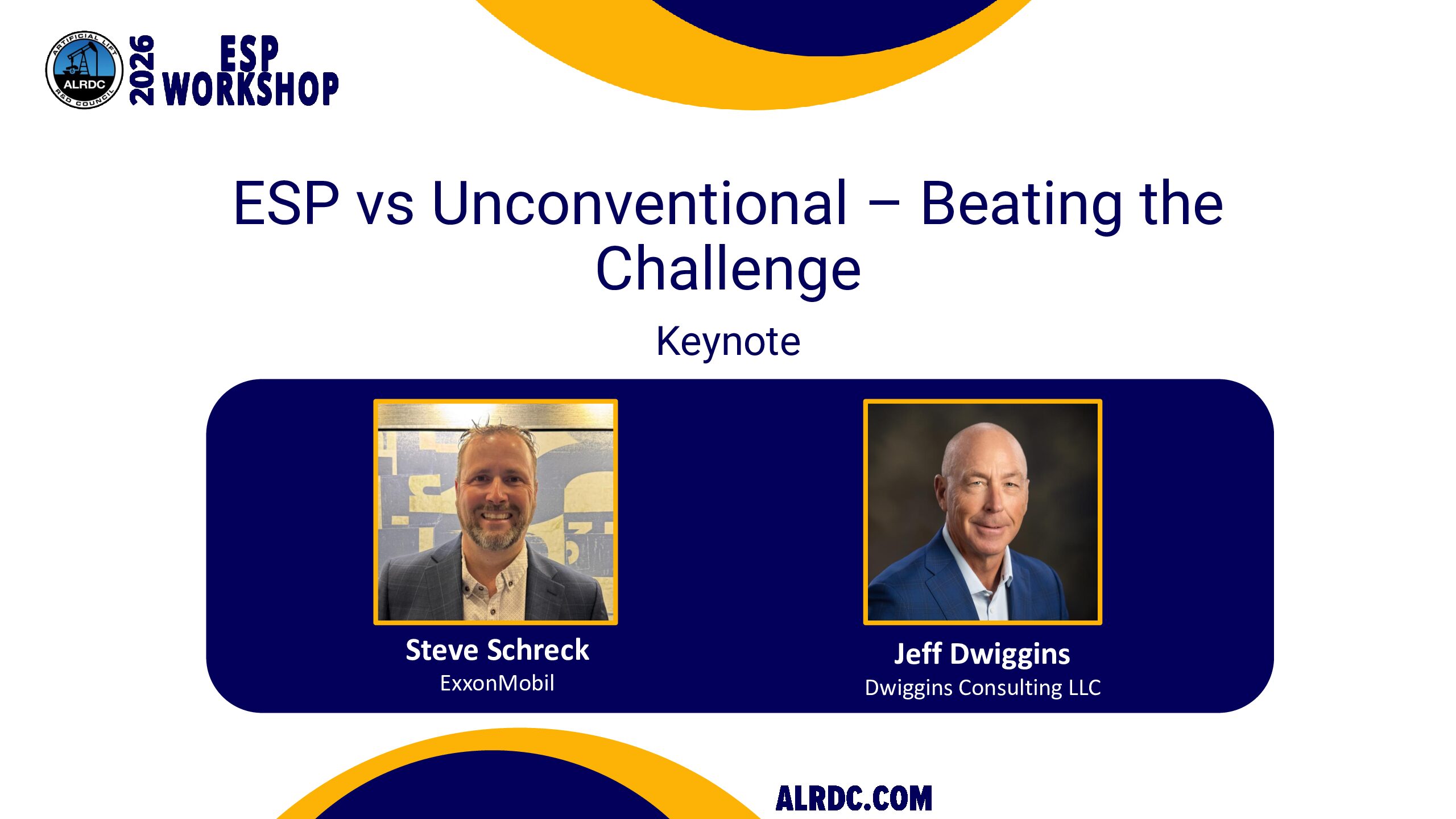
ESP vs. Unconventional – Beating the Challenge

“Two perspectives, in two sections.

Operator (Steve Schreck, ExxonMobil): His “rules to operate by” include keeping it simple and making money, not oil. Challenges include steep declines, infant failures, cable damage, and data quality, with RCFA on 1,280 failures since 1/2025. Results cited: a 420-day average runtime (432-day target), 44 systems past 1,000 days in 2026, and $68.4MM saved through cable reuse. Levers include closed-loop optimization, IPC tubing, vendor KPIs, and standardization after the XTO/Pioneer mergers. The closing message is that success is safe, reliable, economic recovery, not run life alone.
Service provider (Jeff Dwiggins): Unconventional wells are rapidly changing applications, so design for the whole production envelope, not a single point. He argues the assumptions to break include “max production = optimum” and “remote monitoring replaces field staff.” A voltage-optimization example on 20 wells showed 34% lower power use, about 10.7°F cooler motors, and roughly $5,270 saved per well per month. Other themes are installation discipline, aligned incentives, DIFA as a closed loop, and a near miss with a permanent magnet motor (LOTO doesn’t remove voltage from a rotating PMM). His conclusion is that complexity is a catalyst, and shared data and incentives drive improvement.”

ESP vs. Unconventional – Beating the Challenge Read More