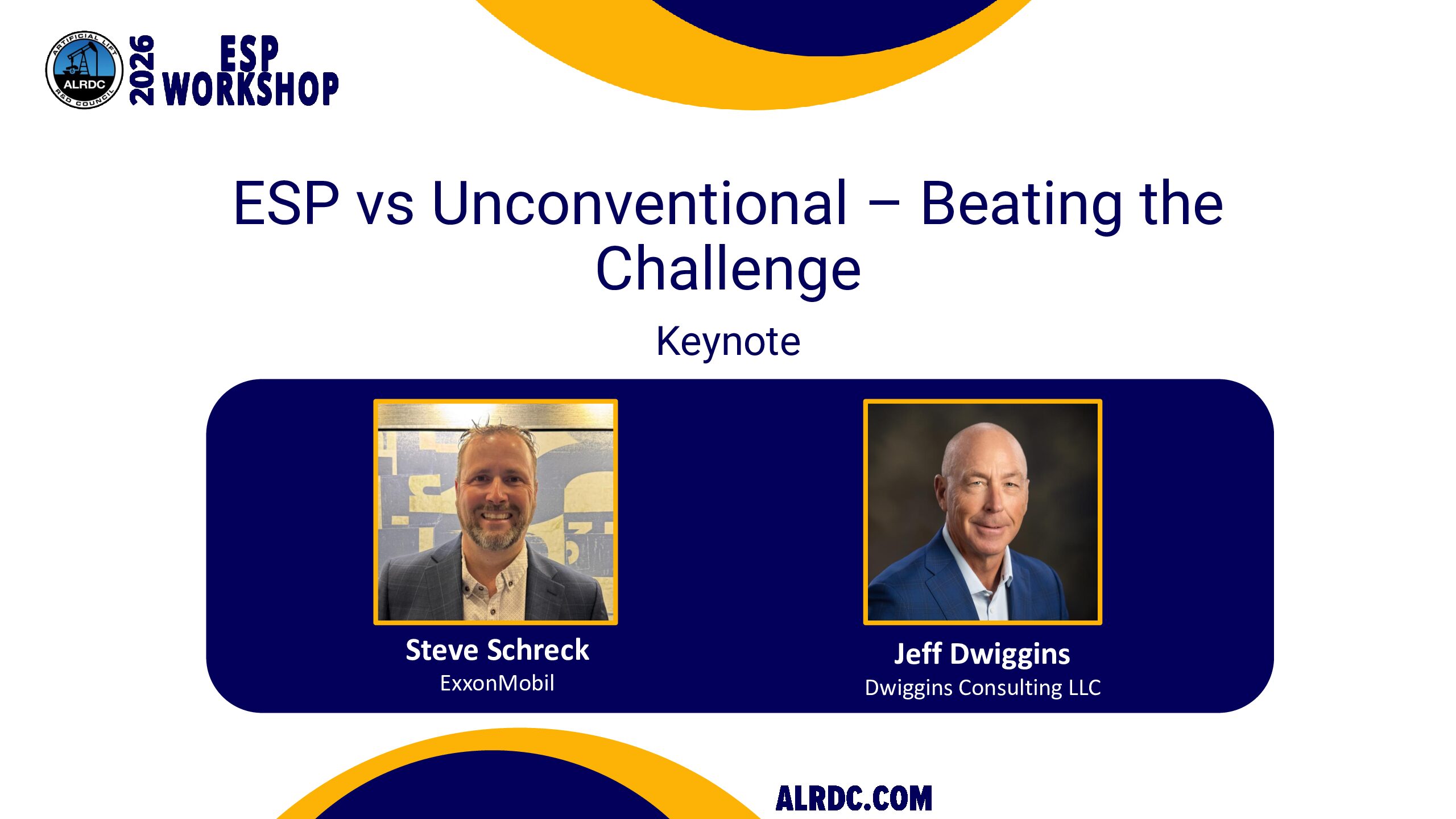
“Two perspectives, in two sections.
Operator (Steve Schreck, ExxonMobil): His “rules to operate by” include keeping it simple and making money, not oil. Challenges include steep declines, infant failures, cable damage, and data quality, with RCFA on 1,280 failures since 1/2025. Results cited: a 420-day average runtime (432-day target), 44 systems past 1,000 days in 2026, and $68.4MM saved through cable reuse. Levers include closed-loop optimization, IPC tubing, vendor KPIs, and standardization after the XTO/Pioneer mergers. The closing message is that success is safe, reliable, economic recovery, not run life alone.
Service provider (Jeff Dwiggins): Unconventional wells are rapidly changing applications, so design for the whole production envelope, not a single point. He argues the assumptions to break include “max production = optimum” and “remote monitoring replaces field staff.” A voltage-optimization example on 20 wells showed 34% lower power use, about 10.7°F cooler motors, and roughly $5,270 saved per well per month. Other themes are installation discipline, aligned incentives, DIFA as a closed loop, and a near miss with a permanent magnet motor (LOTO doesn’t remove voltage from a rotating PMM). His conclusion is that complexity is a catalyst, and shared data and incentives drive improvement.”